
The research
Over fifteen years of research with more than 20,000 ministry leaders.
It started as a question nobody had properly answered: what actually helps the people who care for everyone else?
Scope and method
How the research was conducted
The Flourishing in Ministry Project set out to understand what sustains ministry leaders over a career, rather than only what drives them out. The project continues today at Biola University's Mental Health and the Church Initiative, an arm of Biola's Rosemead School of Psychology, drawing on the broader body of human flourishing research rather than a single study.
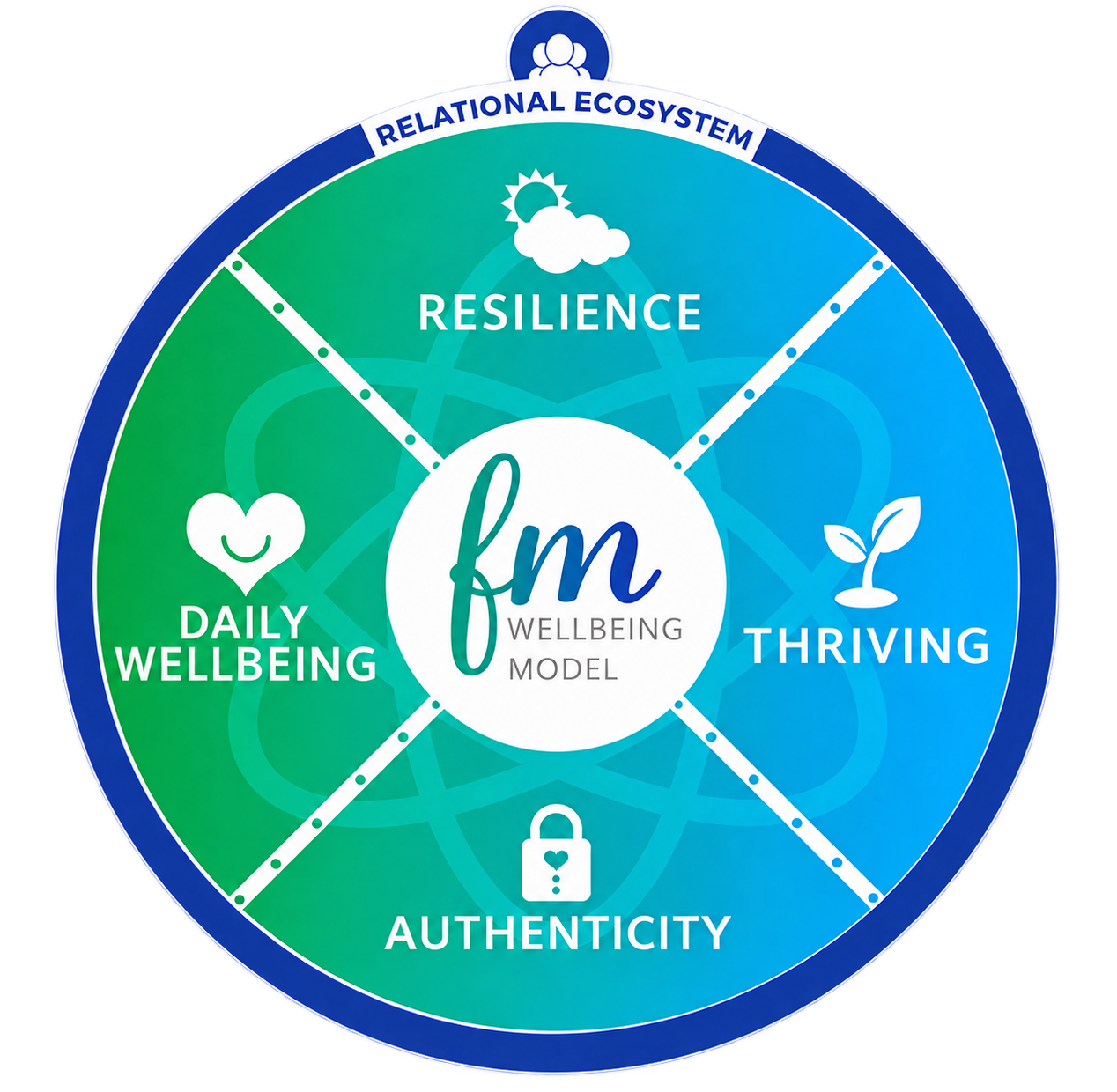
The Flourishing in Ministry model
Five dimensions of flourishing in ministry leadership
Our research points to five dimensions of flourishing. Four of them — Daily Wellbeing, Resilience, Thriving, and Authenticity — grow inside the fifth: your Relational Ecosystem, the web of relationships that holds everything else together.
One — Daily Wellbeing
The quality of your everyday life — sleep, rest, health, and renewal. It is usually the first thing to drop, and when it stays low, it pulls everything else down with it.
Two — Resilience
The capacity to move through hard seasons and grow, not merely endure them. It is built through emotional intelligence — self-awareness, reflection, and regulation.
Three — Thriving
A living sense of meaning and connection — to God, to your purpose, and to people. For many leaders, connection to people is the hardest and most important piece.
Four — Authenticity
Living and leading congruently with your true self — a quiet confidence that grows through self-acceptance and shaping your role to fit who you are.
The fifth, that holds the other four
Relational Ecosystem
The web of supportive relationships across every part of your life — your closest people, peers who carry the same weight, your congregation, and those who lead you. It surrounds and sustains the other four, and a healthy, mutually supportive relationship with your congregation is the single biggest predictor of whether you will flourish.
Findings
Four findings that direct our programs
Finding 01
Calling holds. Daily reserves do not.
Purpose and sense of calling generally remain intact. What declines is daily wellbeing, which is why effective support belongs upstream of crisis.
Finding 02
A quarter to a third of pastors studied were at high to severe burnout.
Most did not identify it in themselves. Six causes recur across the data.
Finding 03
Pastoral work spans thirteen task clusters and sixty-four competencies.
The role carries unusual breadth, high stakes, and no natural stopping point. That is a structural condition, not a personal failing.
Finding 04
Support requires a front stage, a back stage, and time off stage.
Peers carrying comparable weight matter most. Many pastors have no back stage at all.
Publications
Published reports
Original research from the project, free to download.
Report
The science of wellbeing
The building blocks of flourishing and the research behind the model.
Report
Burning out in ministry
What burnout is, the six causes behind it, and what prevents it.
Report
A burden too heavy?
Why pastoral work is so complex: thirteen task clusters and sixty-four competencies in one role.
Report
The stages of ministry
Front stage, back stage, off stage — and why most pastors have no back stage.

Participation
Take part in the research
The Flourishing in Ministry Leadership assessment takes about twenty minutes and returns a reading across all five dimensions. Responses also contribute to the ongoing research that shapes the Initiative's programs.
Take the assessmentNot Just a Newsletter
The Weekly Well
A place to pause, breathe, and draw water for the week ahead — real research, practical tools, and honest encouragement to help you sustain ministry for the long haul.
No spam. Unsubscribe anytime.
