
A Burden Too Heavy: Understanding Workload Complexity in Ministry
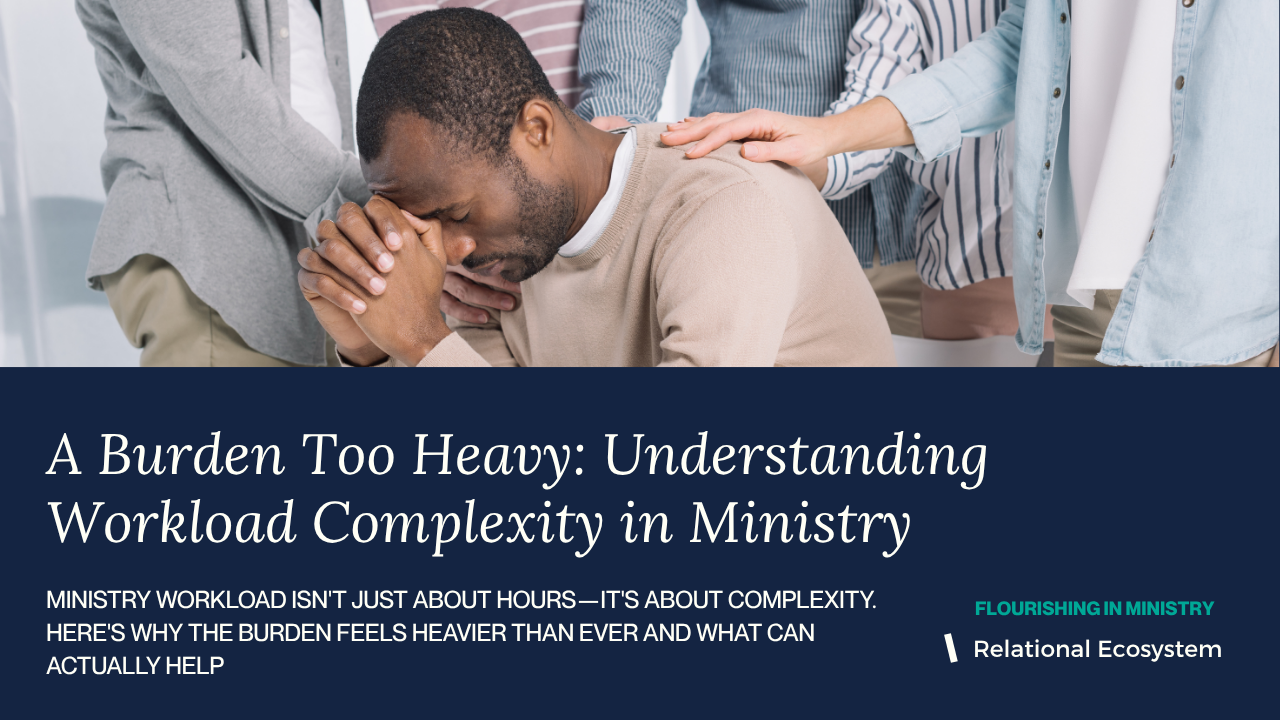
When we ask ministry leaders about their workload, the answers often focus on hours: 50-hour weeks, 60-hour weeks, always-on availability. But hours alone don't capture why ministry feels so heavy.
Research from the Flourishing in Ministry project identifies something deeper: workload complexity. It's not just that pastors work long hours—it's that the nature of the work creates a particular kind of burden that's hard to measure and hard to set down.
Understanding this complexity is the first step toward addressing it.
The Nature of Ministry Workload
Several factors make pastoral work uniquely demanding:
Role multiplicity.
Most pastors aren't doing one job—they're doing five or ten. Preacher. Counselor. Administrator. Fundraiser. Conflict mediator. Event planner. Vision caster. Crisis responder. Website manager. Social media presence. Each role requires different skills, different energy, and different modes of thinking. The cognitive load of switching between roles all day is itself exhausting.
Emotional labor.
Ministry involves constant emotional engagement. You sit with grief, absorb anxiety, navigate conflict, and provide pastoral presence—all while managing your own emotional state. This emotional labor is invisible in most workload calculations but enormously costly.
Boundary porosity.
For most professionals, work has edges. You leave the office. You're off the clock. For pastors, the boundaries are inherently porous. Your work involves people who are also your neighbors, your church family, your community. You can't fully clock out because you can't stop being their pastor.
Urgency and interruption.
Ministry involves constant interruption by genuine human need. Crises don't schedule themselves. Hospital calls don't wait. The unpredictability means you can never fully protect your time or count on completing what you planned.
Visibility and evaluation.
Your work is public. Every sermon is evaluated. Every decision is observed. Every interaction contributes to congregational perceptions of your competence. This constant visibility creates performance pressure that adds to cognitive load.
Meaning and weight.
The work isn't just tasks—it's souls, eternity, kingdom significance. This meaning adds weight to everything. A CEO can have a bad quarter; a pastor worries about spiritual harm.
Why This Matters
When we don't understand workload complexity, we reach for inadequate solutions.
Time management isn't enough. You can optimize your calendar, batch your tasks, and implement productivity systems—and still be overwhelmed. Because the problem isn't just time; it's the nature of what fills the time.
'Work harder' backfires. More effort applied to an unsustainable workload just accelerates burnout. The solution isn't more—it's different.
Comparison misleads. 'Other pastors manage it' becomes a source of shame rather than helpful data. Other pastors may have different gifts, different contexts, different support systems—or they may be heading toward their own crash.
Understanding complexity helps because it names the real problem. The burden isn't just heavy—it's a particular kind of heavy that requires particular kinds of intervention.
What Actually Helps
Research on sustainable ministry points toward several strategies:
Role clarity. What are you actually supposed to do? Not everything that needs doing, but your specific responsibilities. Clarity here allows you to delegate, say no, and focus. If everything is equally your job, nothing is prioritized and everything is overwhelming.
Task reduction. This is different from time management. It's not about doing the same tasks more efficiently—it's about doing fewer tasks. What can you stop doing? What can be delegated? What's tradition rather than necessity? Ministry leaders often need permission to subtract.
Emotional load sharing. You shouldn't be carrying pastoral burdens alone. Staff, lay leaders, denominational supports, peer groups, and professional counselors can share the emotional weight. Building a network that shares the load is essential.
Boundary repair. Even in ministry, some boundaries are possible. Designating off-times and communicating them. Not responding to non-emergencies immediately. Creating space for recovery. These boundaries will be imperfect, but imperfect boundaries are better than none.
Recovery matching. The recovery you need should match the depletion you've experienced. Administrative fatigue needs different recovery than emotional fatigue. Physical exhaustion needs different recovery than spiritual dryness. Understanding what's depleted helps you restore it.
Systemic change. Sometimes the workload complexity isn't fixable by personal adjustments—the system itself needs to change. Staffing needs to increase. Role expectations need to be renegotiated. Congregational culture needs to shift. This is harder than individual change but sometimes essential.
A Word About Congregation Relationships
The Flourishing in Ministry research found something crucial: the quality of the pastor-congregation relationship is the single strongest predictor of ministry flourishing. When that relationship is healthy and mutual—when care flows both directions—workload complexity is more bearable.
But when the congregation-pastor relationship is extractive—when you give and give without receiving care back—the workload becomes crushing. No individual strategy can fully compensate for an unhealthy congregational dynamic.
If you're carrying a burden that feels too heavy, part of the solution may involve honest conversation with your congregation about mutual care. They may not realize the weight you're carrying. They may assume you're fine. They may be willing to shift if someone names the need.
This Week
Take an honest look at your workload—not just the hours, but the complexity. Which elements are most costly? Which burdens are you carrying alone that could be shared? What's one small change that would reduce complexity rather than just manage it better?
The burden doesn't have to stay this heavy. But addressing it requires naming what's actually making it heavy—and that starts with understanding workload complexity.

Subscribe to The Weekly Well
Each week, one practical insight for building sustainable ministry. Short, actionable, research-backed—delivered to your inbox every Tuesday.
